
Introduction: Why Varanasi?
When I told my friends back in America that I was planning to spend an entire month in Varanasi, India, most of them were puzzled. Some asked why I wouldn’t choose a glamorous city like Mumbai, or a Himalayan retreat like Rishikesh. Others wondered if one month in a single city wouldn’t be “too much.”
But to me, Varanasi—also known as Kashi or Banaras—wasn’t just a destination on a map. It was a dream, a calling, and a place I had read about countless times in travel books and spiritual writings. They say Varanasi is the oldest living city in the world, and as someone fascinated by history, spirituality, and cultural immersion, I knew this was exactly where I needed to go.
And so, last week, I packed my bags, boarded my flight, and began a one-month journey across Varanasi that would not only change the way I look at India but also transform the way I see life and death.
First Impressions of Varanasi
The moment I stepped out of the Lal Bahadur Shastri Airport, the air felt different. Not just physically—though the warm winds and slight dust did remind me I was far from my home in America—but spiritually. Varanasi seemed to breathe, almost as if the city itself was alive.
The rickshaw ride to my guesthouse near Assi Ghat was a whirlwind of sounds, colors, and chaos. Cows shared the road with scooters, vendors shouted about fresh fruits and masala chai, and temples seemed to appear on every corner. To an outsider, it might look overwhelming. To me, it was magical chaos, a rhythm I knew I would soon fall in love with.
Life on the Ghats
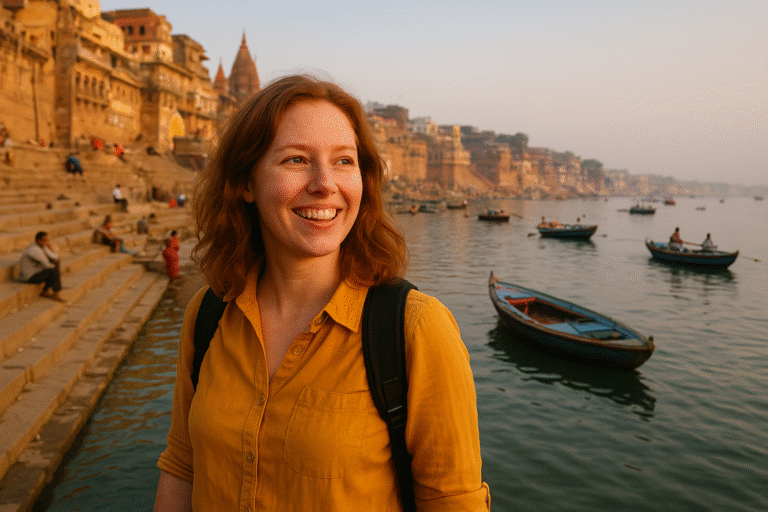
Varanasi is defined by its ghats—the series of stone steps that lead down to the sacred River Ganges. My mornings almost always began with a slow walk along the ghats, where life unfolded in a thousand different ways.
At Assi Ghat, students practiced yoga as the sun rose over the river, painting the sky with hues of orange and pink. Priests performed small rituals, families bathed in the Ganga, and boats lined up to take travelers on sunrise rides.
One of the most unforgettable mornings was my boat ride at dawn. As the boat glided over the calm waters, I watched hundreds of oil lamps float like stars on the river. The chants of mantras echoed from temples, blending with the calls of birds and the splash of oars. I felt as if time had paused just for me.
Every ghat had its own personality. Dashashwamedh Ghat was always crowded and full of energy, especially during the Ganga Aarti at night. Manikarnika Ghat, the main cremation ground, was starkly different—quiet, intense, and deeply humbling. Watching the cremation rituals reminded me of life’s fragility and the peace of acceptance.
Discovering the Spiritual Side
Spending a month in Varanasi gave me more than enough time to dive deep into its spiritual side.
I visited the Kashi Vishwanath Temple, one of the most important Shiva temples in India. The queues were long, the crowd intense, but when I finally reached inside and saw the Jyotirlinga, I felt an overwhelming calm. The temple isn’t just a place of worship—it’s a reminder of faith that has lived for thousands of years.
I also attended morning yoga classes near Assi Ghat, which connected me with both locals and travelers from around the world. The teachers didn’t just teach yoga poses—they spoke about philosophy, balance, and inner peace.
Another highlight was attending music concerts featuring Banarasi classical music. The sound of the sitar, tabla, and the soulful singing made me realize why Varanasi is also called the cultural capital of India.
Food Adventures in Banaras
No travel blog is complete without food—and in Varanasi, food itself felt like a spiritual journey.
- Breakfasts often started with kachaudi sabzi (fried bread with spicy potato curry) and jalebi dripping with syrup.
- Street corners tempted me with chaat—tamatar chaat, aloo tikki, and dahi puri that burst with flavors.
- Of course, no evening in Varanasi was complete without a glass of creamy lassi, served in traditional clay cups.
- One unforgettable dish was the Banarasi paan—a betel leaf stuffed with sweet and aromatic fillings. It’s not just food; it’s a tradition, a symbol of hospitality.
For coffee lovers like me, there were also cozy cafés run by young locals and international travelers, blending modern tastes with the charm of Banaras.
Exploring Beyond the Ghats
Though the ghats were my favorite, Varanasi offered so much more.
I visited Sarnath, just a short ride away, where Lord Buddha gave his first sermon. Walking through the ruins, stupas, and the famous Dhamek Stupa, I felt the silence of history whispering around me.
The narrow alleys of old Banaras were another adventure. They twisted and turned, hiding centuries-old temples, tiny shops selling Banarasi silk sarees, and secret sweet shops. I often got lost, but in Varanasi, getting lost felt like the only way to truly find the city.
Shopping was another delight. I bought a Banarasi saree—a timeless piece of art that Varanasi is world-famous for. Though I may never wear it in my daily life in America, it is a treasure, a memory woven in silk.
Festivals, Rituals, and Daily Wonders
Spending an entire month meant I was lucky to witness not just the daily life but also the festivals.
One evening, I saw the grand Ganga Aarti—a mesmerizing ritual where priests waved giant oil lamps, conch shells blew, and the entire ghat lit up with devotion. The energy was so powerful that it gave me goosebumps.
I also witnessed small, intimate rituals—like a family performing a mundan ceremony (head shaving for children) or locals offering diya (lamps) to the river. Every act, big or small, seemed infused with meaning.
Reflections on Life and Death
Varanasi is not just about life—it’s also about death. Spending time near Manikarnika Ghat, I saw funeral pyres burning day and night. It was intense at first, but soon I understood the philosophy.
For Hindus, dying in Varanasi and being cremated on the banks of the Ganga is the ultimate liberation, or moksha. It was a stark reminder that life is temporary, but the soul, the spirit, is eternal.
This understanding changed me. I came to Varanasi as a traveler, but I left as someone who had learned to see life and death with a little more acceptance, a little more peace.
Practical Travel Tips for Varanasi
For anyone planning a long stay like me, here are some things I learned:
- Stay near the ghats—Assi Ghat is peaceful, Dashashwamedh is lively.
- Embrace the chaos—The traffic, noise, and cows on the road are part of the charm.
- Respect local customs—Dress modestly near temples, and always ask before photographing rituals.
- Food safety—Street food is delicious, but stick to busy stalls with high turnover.
- Explore slowly—Varanasi isn’t meant to be rushed. Walk, sit, observe. The magic is in the details.
Conclusion: What Varanasi Gave Me
After a month in Varanasi, leaving wasn’t easy. The city had become more than just a place—it had become a teacher.
It taught me that chaos can be beautiful. That life and death are two sides of the same river. That food, music, rituals, and even a simple boat ride can hold deep meaning if you allow yourself to feel it.
Varanasi isn’t for everyone. It’s raw, intense, and sometimes overwhelming. But if you are willing to open your heart, it will give you experiences and lessons that no other city in the world can.
As my flight took off, I looked down at the winding Ganga and whispered a promise—to return again. Because once you’ve been to Varanasi, you carry a part of it with you forever.