
By Karl – An American Traveler’s Journey through the Heart of India
Introduction: My First Encounter with New Delhi
When I stepped off the plane at Indira Gandhi International Airport last week, the air of New Delhi hit me with a medley of fragrances, warmth, and an invisible pulse that felt almost alive. I had traveled across continents to finally stand in the city that has, for centuries, been the epicenter of power, culture, and tradition in India.
As an American traveler who has seen cities like New York, Los Angeles, and Washington D.C., I was immediately struck by the contrast. New Delhi was both chaotic and calm, ancient and modern, traditional and futuristic. It is a city where Mughal architecture touches colonial buildings, where street food vendors stand beside luxury malls, and where people of diverse religions and languages coexist under one sky.
This blog is my attempt to recount my journey exploring New Delhi’s streets, temples, mosques, forts, gardens, museums, neighborhoods, and its fascinating culture that connects India not only internally but also with the world across its borders.
Day 1: The First Morning in Delhi – Old Delhi’s Timeless Charm
On my first morning in Delhi, I decided to head straight into the heart of Old Delhi. This part of the city is where history breathes from every stone, where narrow lanes whisper tales of emperors and poets.
Jama Masjid – The Soul of Old Delhi
My first stop was Jama Masjid, India’s largest mosque, built by Emperor Shah Jahan in 1656. Standing at the steps, I was overwhelmed by its sheer grandeur. The vast courtyard can hold 25,000 worshippers at once. I removed my shoes, felt the cool marble under my feet, and gazed up at the mighty domes and minarets.
The call to prayer echoed in the background, blending with the sound of pigeons fluttering across the sky. I could feel centuries of devotion embedded in its walls. For a moment, I felt as though I had stepped back into the Mughal era.
Chandni Chowk – A Feast for the Senses
From the mosque, I strolled into Chandni Chowk, the legendary market street that has fed Delhi’s appetite for over 300 years. Imagine narrow lanes overflowing with people, cycle rickshaws weaving through traffic, and shopkeepers calling out their goods – that was my welcome.
Food was my main goal here. I tried:
- Paranthas at Paranthe Wali Gali – stuffed with potatoes, paneer, and even cashews.
- Jalebis dripping with syrup, crunchy on the outside and soft inside.
- Chole Bhature – a spicy chickpea curry with fluffy fried bread that left me speechless.
The energy of Chandni Chowk is unfiltered. It’s not polished or sanitized for tourists – it’s real Delhi.
Red Fort – The Emblem of India’s Independence
By afternoon, I reached the Red Fort (Lal Qila), another Shah Jahan masterpiece. Its red sandstone walls stood tall against the blue sky. Inside, I wandered through Diwan-i-Aam (Hall of Public Audience), Diwan-i-Khas (Hall of Private Audience), and the royal gardens.
But what moved me most was knowing that on 15th August 1947, Jawaharlal Nehru delivered India’s first Independence Day speech from here. Standing at that very spot, I felt the power of history echo through time.
Day 2: The Green and Colonial Heart of New Delhi
On the second day, I explored Lutyens’ Delhi – the colonial part of the city designed by British architect Edwin Lutyens. It was an entirely different world compared to Old Delhi. Wide boulevards, green gardens, and massive government buildings dominated the landscape.
India Gate – The Arc of Triumph
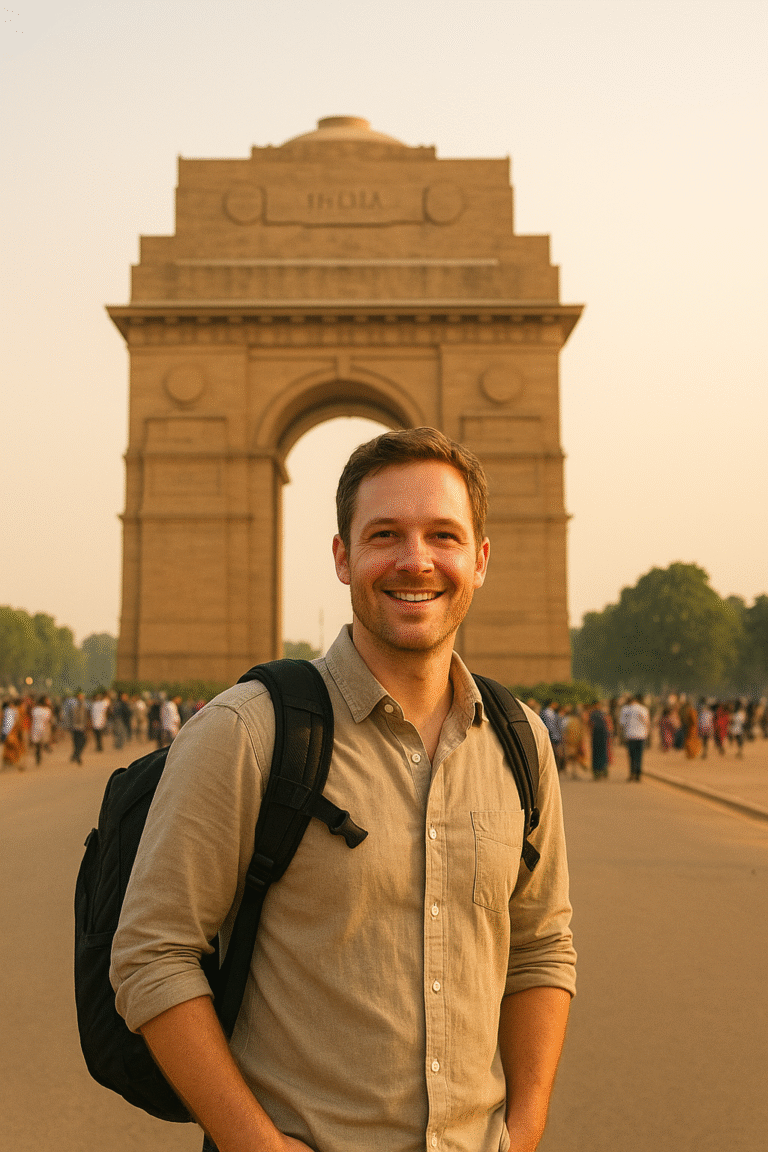
Modeled after Paris’s Arc de Triomphe, India Gate stands tall as a war memorial for over 70,000 Indian soldiers who died in World War I. The eternal flame, Amar Jawan Jyoti, burns in honor of martyrs. Families picnicked on the lawns, children flew kites, and vendors sold ice cream.
For me, India Gate represented India’s sacrifices and resilience – a landmark that connects the past with the present.
Rashtrapati Bhavan and Rajpath
Driving down Rajpath (now Kartavya Path), I reached the grand Rashtrapati Bhavan, the President of India’s official residence. With its sprawling gardens and domed architecture, it symbolizes India’s transition from colonial rule to democracy.
Lodhi Gardens – Peace Amid Chaos
In the afternoon, I found myself wandering through Lodhi Gardens. This green paradise holds tombs of Lodhi dynasty rulers from the 15th century. Joggers, young couples, and families filled the park, but the serenity remained untouched. I sat under a tree, watching the blend of life and history coexist peacefully.
Day 3: Spiritual Delhi – Temples and Faith
New Delhi is not just about monuments; it’s about spirituality that transcends religions.
Akshardham Temple – A Modern Marvel
The Akshardham Temple left me awestruck. Though built in 2005, its intricate carvings looked like something from centuries ago. The light and water show in the evening depicted the eternal values of Indian culture.
Lotus Temple – The House of Silence
Shaped like a blooming lotus, this Baháʼí temple welcomes people of all faiths. Sitting in its silent prayer hall, I felt a sense of inner calm I hadn’t experienced in a long time.
Gurudwara Bangla Sahib – The Sikh Spirit of Service
At Bangla Sahib Gurudwara, the golden dome shone under the sun. Inside, the melodious kirtan filled the air, while outside volunteers served free food at the Langar. Eating a simple meal of dal and roti with strangers reminded me of humanity’s true essence – equality.
Day 4: Museums, Art, and Culture
Delhi is also the cultural capital of India, home to countless museums, theaters, and art galleries.
- National Museum – artifacts from the Indus Valley Civilization to modern India.
- Crafts Museum – showcasing rural India’s traditional arts.
- Dilli Haat – an open-air market where I bought handicrafts from Rajasthan, Kashmiri shawls, and Naga jewelry.
- National Gallery of Modern Art – paintings and sculptures by Indian masters.
Each corner of Delhi had something to teach me about India’s soul.
Day 5: Borders, Connections, and Beyond
What fascinated me most was how Delhi acts as a cultural and geographical connector of borders.
- From Delhi, one can feel the pull of Punjab’s spirit, Rajasthan’s deserts, Haryana’s fields, and Uttar Pradesh’s sacred cities like Varanasi and Agra.
- Delhi’s cuisine borrows flavors from Persia, Central Asia, and neighboring states.
- Its people reflect India’s unity in diversity – Hindus, Muslims, Sikhs, Christians, Jains, and Buddhists, all shaping the city’s rhythm.
Even in a global sense, New Delhi is India’s face to the world. It is where international leaders meet, where borders blur, and where cultures merge.
Food, People, and Everyday Life
What’s Delhi without its food? Beyond Chandni Chowk, I savored:
- Butter Chicken at Moti Mahal (where it was invented).
- Street-side momos with spicy chutney in Lajpat Nagar.
- South Indian dosa and idli at Saravana Bhavan.
- Fine dining at Indian Accent – a fusion of modern and traditional flavors.
The people of Delhi fascinated me. Some were in a rush, some eager to help, some curious about me as a foreigner. I was offered tea multiple times by strangers, and each conversation opened a window into Indian warmth.
Reflections: What Delhi Taught Me
After a week in Delhi, I realized that this city cannot be defined in a single word. It is:
- A museum of empires – from Mughals to British to modern India.
- A living bazaar – where every lane has a story.
- A spiritual hub – where temples, mosques, churches, and gurudwaras coexist.
- A modern capital – with skyscrapers, metros, and high-tech life.
Delhi taught me that borders – whether religious, cultural, or national – are not walls but bridges. It connects people across time, faiths, and lands.
Conclusion: My Promise to Return
As my plane took off from Delhi, I looked out of the window and saw the city lights twinkling below. I carried with me more than just souvenirs – I carried stories, flavors, and friendships.
New Delhi is not just a destination; it is an experience, an education, a journey into India’s beating heart. And as Karl, an American traveler, I can say this with certainty: Delhi is not just a city you visit once; it’s a city you return to, again and again.