
By Huang
When my company asked me to fly to Nepal for a week-long assignment in communications infrastructure, I pictured neat timelines, polite meetings, and the quiet satisfaction of technical work done well. I pictured Kathmandu’s terraced hills from a plane window, the rhythm of a new city, and then—back to the routine of home. I never imagined that a business trip would become a flight for my life: chased, humiliated, and running sixty kilometers through the night to escape a crowd that could have killed me.
This is the story of those hours, and the days that followed. It is the account of being caught in the crossfire of generational anger, of the indifference of some strangers and the courage of the few who chose to help. It’s a piece written with trembling hands and slow breath, because I came back; I did not perish. But I was very close.
The Assignment and a Quiet Optimism
I had worked on international projects before. As a communication engineer, I give routine to networks—ensuring signals pass, antennas are aligned, and mobile towers relay voices across mountains and borders. The project in Nepal was straightforward: assess a set of remote BTS (base transceiver stations) installations and supervise minor upgrades. The trip was short, three days on the ground before returning to China.
On arrival, Kathmandu felt like many cities I had traveled to—busy, a little chaotic, alive. My schedule was tight: a morning meeting with the local telecom contractor, an afternoon field visit, and an evening document review. I checked into a modest guesthouse recommended by the local office, had a light meal, and set my alarm for an early start. The night was uneventful; I remember falling asleep to distant traffic and some late-night laughter in nearby lanes.
If only this were the end of the story.
Rumors and Warnings
Early the next morning, the contractor’s local manager called with a caution in his voice: “There are demonstrations. Young people. They have been on the streets since dawn.” In my head, I catalogued possibilities—small union protests, traffic disruptions—but the manager’s tone suggested something else: a swelling unrest that might not be contained to a single neighborhood.
At the office, the mood was tense. Co-workers were checking messages, setting up contingency plans. A senior Nepali engineer said, “They are Gen Z. They are angry. They want to be seen.” He spoke in the mixture of English and Nepali that had become familiar to local teams: hurried, practical, and weary.
I had seen protests in other countries—organized marches with permits, lines of police keeping distance, journalists and observers threading cautiously through. Those were not what I was seeing on my phone’s screen as images and short videos came through: small groups of youth blocking intersections, burning tires, and—most alarmingly—groups detaining passersby. The tone of the messages shifted quickly from curiosity to worry. One colleague said, “Do not travel alone.”
I interpreted “do not travel alone” as professional caution. I was stubborn. I had work to do. And I had never been the type to cower easily. I thought I could manage. I was wrong.
The First Encounter: From Observation to Target
At midday, I left for the site with a field technician and a driver. The route was predictable; the streets were not. At the first major junction, a group of young people had formed a blockade. They were chanting, waving placards, and arguing with drivers who tried to force their way through. Our van slowed. A man in his early twenties climbed onto the hood of another vehicle and shouted through a megaphone about corruption, unemployment, and the failure of senior leaders to deliver promises.
We tried to turn around. The driver attempted a detour through narrower lanes. That’s when a squad of three youths jumped in front of our van and signaled for us to stop. They were not just blocking traffic. They were inspecting vehicles and interrogating whoever was inside. One of them signaled for us to open the door.
My heart went cold. Inside my pocket, I had my ID card, passport copy (thankfully not the original), and a corporate access card. I had no intention of getting into an argument or giving them cause to escalate things.
The leader looked at me, then at my face, then at my pale skin. He asked in rapid Nepali mixed with English, “Where are you from? What is your business?” I answered in the clearest English I could: “I am a communication engineer. I’m here for a technical inspection.” For reasons I cannot explain now—perhaps the visibility of a corporate badge, perhaps his fatigue—he waved us on. We left with racing hearts.
I thought that was the end of it. But I was wrong again.
The Attack: Humiliation and Abandonment
Later that evening, as I walked through a commercial street back towards my guesthouse, the crowd felt larger and angrier. I saw groups of young men and women setting barricades, overturning small vendor carts, and pushing anyone who hesitated to move. The contactless safety of daylight had shifted into something rawer, personal.
Suddenly, the crowd surging towards me grew denser. A hand grabbed my shoulder. I tried to push past, asking, “Excuse me.” Someone snapped, “You! Where are you from?” Panic rose like bile in my throat. I said, “China. I am here for work.” For a brief, terrible moment, I thought they would let me go. But their faces hardened.
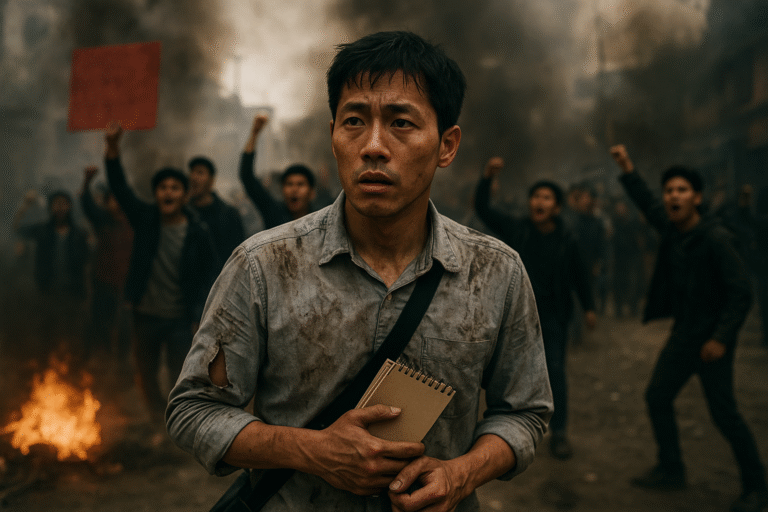
They separated me from the flow. A young woman screamed something, and a group closed in, pulling at my clothes. I tried to hold them back. They tugged with hands like iron. My jacket was torn at the shoulder. Another youth pulled at my shirt collar. One of them spat in my face. The world narrowed down to the itch of fabric ripping, the taste of dust, the sting of humiliation.
No one helped. I remember looking around desperately. There were hundreds of people; there were many who did not join in the attack. Some looked away, hands to their faces. Others filmed on their phones. A cluster of older shopkeepers had retreated into a doorway, peering as if watching a storm that was not theirs. My pleas were swallowed by the chant of the crowd.
I felt naked in a way more profound than the torn fabric on my body. I felt exposed and expendable.
A voice finally broke through—someone shouting, “Get him! He’s foreign!” Another voice yelled, “We must show them we are serious!” They pushed, shoved, and pulled until my clothes were badly damaged. In those moments, the crowd’s anger transferred from abstract protest to direct assault.
When the aggression stopped, I staggered away, heart pounding, chest heaving. My hands were shaking so hard I could hardly button the few remaining fastenings on my shirt. I wrapped the torn fabric around my chest and retreated into a narrow lane, hoping to disappear.
I searched for help: a security guard, a local police post, any adult who might defend me. There was none. My phone barely had signal and the emergency numbers went unanswered. My colleagues had advised to stay in groups; but that advice did not help in that moment. I was alone.
The Decision to Run
Sitting in a cramped alcove behind a shuttered storefront, I assessed my options. My clothes were ruined; my pride worse, but my life—my immediate safety—was my only tangible concern. The crowd might return. If they did, I doubted they would be merciful a second time.
The only rational decision was to move away from the center of the disturbance, and fast. But where to? I had no map of safe zones. The contractor’s office was too close to the area. The guesthouse was in the heart of the city. I had to put distance between myself and the mob.
I stumbled to the main road and hailed a taxi, expecting a driver to open his door and promise sanctuary. The driver looked at my torn shirt, the dried grime on my face, and shook his head. “Too dangerous, sir,” he said, and drove off.
I realized, with a clarity that felt like a cold wave, that survival meant leaving the city limits, and sooner rather than later.
How far could I go on foot? My legs were tired; my clothes were torn; adrenaline kept my body functioning. I thought about the nearest highway. If I could reach a bus or a highway out of the city, perhaps I could blend in with other travelers and make it to a safer town.
And so I ran.
Sixty Kilometers Through Fear
Covering sixty kilometers sounds like the kind of distance athletes brag about. When you’re running for your life, the distance is simply a measure of how long fear can last.
That first hour was a blur of streets: narrow alleys, markets closed and dark, the occasional flare of a burning barricade. I went without water for a long stretch because every open source of water was either a shop that was closed or a vendor who was too frightened to come outside. I ran with a satchel that felt like a dead weight of everything I had left.
The city’s outskirts offered no safety at first. There were roadblocks placed by protesters, and every time I approached a checkpoint, I skirted it like a ship avoiding reef. If I saw a cluster of youths, I ducked into a lane and waited, breathing through the ache in my lungs. I moved only at certain moments, when the group’s attention turned elsewhere.
At one point, exhausted and despairing, I tried to hitch a ride on a passing pickup. The driver, upon seeing me with torn clothing and dust on my face, made a split-second decision. He rolled up the window and sped away. I understood: in those days, self-preservation became a currency every person guarded tightly.
Night fell. The world changed into shadow and silhouette. My phone battery dwindled to a sliver. The highway was a line of distant lights, a promise of escape. I kept moving toward it.
By midnight, my feet ached like knives. My lungs burned with each breath. I passed small villages and hamlets where some lights were on—people peeking curiously from their homes—but rarely did anyone invite me in. Once, an elderly couple spoke to me in Nepali. They offered me boiled roots and a place to rest. I accepted, though I stayed only long enough to regain a little strength; staying meant risk. The road called me again.
I walked and ran by turns, alternating sprints with slow trudges, following the moon and streetlights, guided by the ache in my heart that would not be soothed by stopping. I fell twice. Each time I scrambled up, wiped the dirt from my palms, and kept going.
Through the night, the protests raged in the city. I could hear distant shouts and the echo of bangs—whether fireworks or something else, I couldn’t tell. I knew that if I stopped, the crowd could find me. I kept moving.
At around 3 a.m., I encountered a small checkpoint manned not by protesters but by a group of civilians—farmers, by the look of their callused hands—who were trying to keep peace. They eyed me suspiciously at first, then with a softness I had not known all night. One of them—a woman with silver hair—wrapped a shawl around my shoulders and offered me some warm tea. Her eyes met mine and she said in broken English, “Hurry. Go to the highway. There are buses early.” Her compassion felt like a narrow bridge leading me back to humanity.
By dawn, my clothes were stained, my feet blistered, but I had reached a small transit town approximately sixty kilometers from the city. I collapsed onto a bench at a roadside tea stall, and the owner—perhaps reading my exhaustion—called a friend who could lend me a phone and a charger.
I sat there, motionless for a long minute, tasting the bitter tea, remembering the feeling of hands on my clothes, the spit in my face. The world had narrowed to two primary facts: I was alive, and I had to find a way home.
The Kindness of Strangers
If the worst of my experience was the attack and the lonely run, the best—paradoxically—came in the form of the kindness I received afterward. The Nepali people who I met on the road, in small towns and market stalls, did not see me as an outsider to be suspected. They saw me as a fellow human in need.
A local bus driver—an older man whose face was weathered by years on the road—agreed to take me the rest of the way toward the border for a small fare. He trusted me with a story I could barely form across my broken English. At one pre-dawn checkpoint, two young men who had been part of the protests hours earlier noticed my torn clothes and tabled their slogans for a few minutes. They handed me a packet of dry biscuits and said, “Sorry, old man.” They were laughing nervously, perhaps embarrassed. Their gesture was awkward but sincere.
In a roadside clinic, a nurse cleaned my abrasions without asking for papers. She bandaged my hands and offered me a simple blessing that felt like a stitch in the tattered fabric of my nerves. “Rest,” she said in Nepali, which I pretended to understand.
When news finally reached our embassy liaison—days later, after many calls and frantic messages—they arranged for an evacuation route, contact with family, and medical attention back home. But long before institutional help arrived, it was these small mercies—the bus driver, the woman with the shawl, the nurse—who had carried me.
I often think about moral calculus: which parts of a society will choose violence, and which will choose compassion? The same streets that saw cruelty to me later saw these small acts of mercy. Human behavior is not monolithic. In a crowd filled with anger, there were individuals who reached out. I am grateful to them beyond what words can capture.
Returning Home and the Aftermath
I returned to China with physical scars—bruises, cuts, and a body that betrayed its limits with every step. But the more complex damage was internal: humiliation, a shaken sense of safety, and a gnawing distrust that was harder to mend than any torn shirt.
At the hospital, doctors cleaned and stitched superficial wounds. A psychologist spoke to me briefly, offering a strategy to deal with panic attacks and sleepless nights. I followed their advice because the nights without sleep had been the worst of all—the mind replaying the attack in loops until dawn.
When I spoke to colleagues and friends, I encountered a spectrum of emotion: sympathy, anger, and a few people suggesting I should never travel again. My family worried. My employer tightened travel protocols and sent a letter urging caution for anyone visiting politically unstable regions. That made sense; businesses must protect their people. But the emotional fallout stayed with me.
At the same time, I knew the dangers of generalization. Not every Nepali was my attacker; many of them had saved me. The Gen Z movement that had surrounded me with hostility was not a monolith. Its anger had legitimate sources: a squeezed economy, limited opportunities, and often a lack of trust in institutions. My story was one human narrative threaded into a larger national crisis.
Reflections: What I Learned and What I Want Others to Know
There are things I can say now with some clarity—lessons paid for in fear and stitches.
First: when you travel for work or pleasure, listen to local warnings. My arrogance and professional commitments made me underestimate the volatility of the moment. Heeding advice from local colleagues and avoiding hotspots might have kept me safe. Don’t be stubborn in the face of real danger.
Second: wear modestly, and carry the bare minimum. There’s a terrible innocence in assuming cloth protects you from violence. It does not. In moments of mass anger, belongings become irrelevant; your presence is what will be judged. A torn shirt is small compared to the trauma of being targeted. Keep emergency contacts accessible and have multiple ways to contact your embassy or local help.
Third: do not dehumanize the young people who protest. Their actions can be violent, but the root causes of their anger deserve attention. Economic stagnation, a feeling of being unheard, and decades of unmet promises create tinder for unrest. Violence is not defensible, but understanding motive helps us see the problem’s depth.
Fourth: in times of crisis, small kindnesses matter most. The bus driver, the woman with the shawl, the nurse—these people showed me that goodness persists even amid chaos. When institutions fail, human compassion still often stands.
Finally: avoid simple narratives. The world is messy. A country can be both beautiful and broken. People can be both cruel and kind. As someone from China who experienced humiliation abroad, I must be careful not to let fear harden into prejudice.
To Readers: Practical Advice and a Hopeful Note
If you travel to Nepal or any place experiencing civil unrest:
- Monitor local news and embassy advisories closely.
- Register with your embassy or consulate.
- Avoid crowds and protest areas. If you accidentally enter one, keep calm, avoid eye contact, and leave slowly if possible.
- Travel with trusted local guides when you can.
- Keep a backup phone, extra battery, and emergency cash on you.
- Learn a few essential words in the local language or have them written down: “help,” “I’m lost,” “hospital,” and “police.”
- Finally, remember that people are not their governments. Some of the kindest people I met were Nepali.
I hope my story serves as both a caution and a testimony: caution about the fragility of safety in volatile situations, and testimony to the small but vital kindnesses that can save a life.
Closing: A Life Marked by a Night
I went to Nepal expecting a technical mission and calm nights. What I received was a night run that stretched on for hours and across sixty kilometers, a moment of deep humiliation, and a gift of unexpected human kindness. I am physically healed but emotionally altered. My trust is frayed in places, but my appreciation for quiet generosity has grown.
If anything good came out of this, it’s the awareness that human stories are rarely simple. Protesters with righteous anger can become attackers in a crowd; farmers can be saviors on the roadside. Governments and institutions can falter, but individual compassion endures. I am grateful to the Nepali people who helped me when help from others failed to arrive.
I tell this story not to inflame, not to blame an entire nation or generation, but to document a single human experience within a larger social moment. If you read this and think you’re immune to such things—you are not. If you read this and feel fear—be careful, but do not let fear alone guide your life. And if you read this and feel empathy—then carry it into the world. When chaos surrounds us, it is often the small acts of love and courage that matter most.
I am Huang, a communication engineer from China. I went to Nepal for work and came back with scars and gratitude. I ran sixty kilometers through the night to save my life. I survived because of the kindness of people who might have been strangers but behaved like kin. I will remember them, and I will tell their story along with my own.