
Introduction – The Call of Divinity
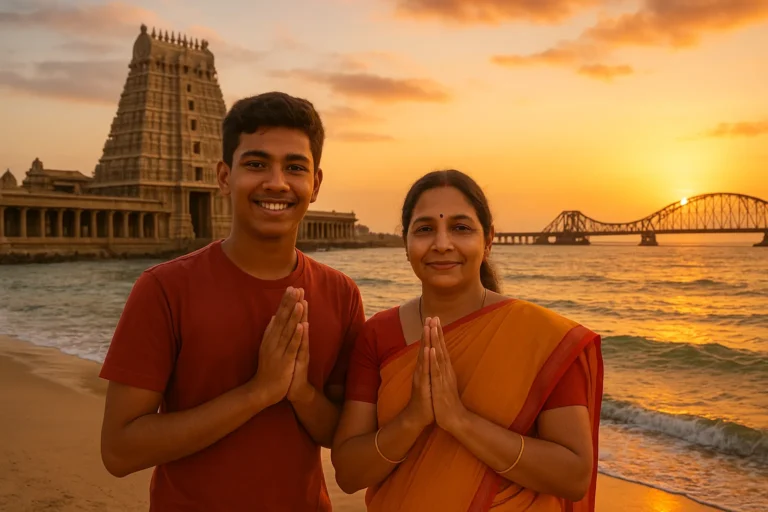
I am Sudhakar, an 18-year-old traveler from India, and last month, I embarked on one of the most soul-touching journeys of my life — a pilgrimage to Rameswaram with my beloved mother. For years, I had heard about the spiritual power of Rameswaram — the place where Lord Rama himself prayed to Lord Shiva after his victory over Ravana. It’s not just a destination; it’s a bridge between faith and salvation, between history and heaven.
From the moment we planned the trip, something deep within me felt awakened — as if Lord Rama himself had called me to his holy land. My mother, who had long dreamed of visiting this sacred place, was filled with joy, and together we decided to take this blessed journey.
Arrival in Rameswaram – The Sacred Air of the Sea
As our train rolled into Rameswaram Railway Station, the first thing that touched me was the cool, salty breeze from the ocean — it felt like a divine whisper welcoming us. The town was calm, filled with chants of “Jai Shri Ram! Har Har Mahadev!” from the temples nearby.
We took an auto to our lodge near the Ramanathaswamy Temple, the heart of Rameswaram. The streets were alive with pilgrims from all over India — some barefoot, some with wet clothes after a holy dip, and others carrying coconuts and flowers for puja. Every corner echoed devotion.
That night, as we prepared for our temple visit, I felt a strange mix of excitement and peace. I couldn’t wait to see the legendary temple where even Lord Rama had worshipped Lord Shiva.
Ramanathaswamy Temple – The Heart of Rameswaram
The next morning, before sunrise, we went to the Ramanathaswamy Temple, one of the twelve Jyotirlingas of Lord Shiva. It was still dark when we reached the entrance, but the temple complex was already crowded with devotees chanting and queuing for the early darshan.
The temple’s massive corridors, stretching endlessly with 1,212 beautifully carved pillars, stunned me. The ancient Dravidian architecture, with its towering gopuram, was breathtaking. Every step felt like a passage into time — a journey into centuries of faith and devotion.
Before entering the sanctum, we performed the 22 Theertham bath ritual. My mother explained that each of these 22 holy wells inside the temple represents a sacred energy point, washing away different sins and purifying the soul.
We started from the first well — the water was cold and sweet. The priest poured it over my head, chanting ancient mantras. By the time we finished all 22 wells, I felt completely renewed, as if I had been reborn. My mother’s face glowed with divine peace.
Inside the sanctum, we bowed before Lord Ramanathaswamy, the Shiva Linga installed by Lord Rama himself. It is believed that Rama, after defeating Ravana, wanted to absolve himself of the sin of killing a Brahmin (Ravana was a Brahmin king). So he worshipped Lord Shiva here and established this linga. Standing before it, I felt a sacred connection between man and God.
Agni Theertham – The Sacred Shore
After visiting the temple, we walked to the seashore — Agni Theertham, one of the most sacred water bodies in India. The sunrise over the Bay of Bengal was mesmerizing — the orange light reflected on the gentle waves, creating a golden path across the sea.
It is believed that taking a dip here washes away all sins. My mother and I stood together in the shallow water, folded our hands, and prayed. The water was cool, and the atmosphere was pure silence except for the rhythmic chanting of priests performing rituals for ancestors.
I remembered reading that Lord Rama had taken his first bath here before worshipping Lord Shiva. As the sea waves touched my feet, I felt as though I was connected to that divine past.
Panchmukhi Hanuman Temple – The Power of Devotion
Our next stop was the Panchmukhi Hanuman Temple, just 2 kilometers from Ramanathaswamy Temple. This temple holds the floating stones that were used to build the Rama Setu (Adam’s Bridge). The stones indeed float on water — a living miracle that still stands as testimony to Lord Hanuman’s strength and devotion.
The idol of Hanuman here has five faces — Hanuman, Narasimha, Garuda, Varaha, and Hayagriva. Each represents a different divine power. As I stood before him, I could feel his fierce energy. The air around the temple vibrated with chants of “Jai Bajrangbali!”
My mother, a great devotee of Hanuman, closed her eyes and prayed deeply. I too bowed my head and thanked Hanuman for guiding us safely on this journey.
Gandhamadhana Parvatham – The Ancient Footprints of Lord Rama
We then visited Gandhamadhana Parvatham, the highest point in Rameswaram. From here, the entire island looked peaceful and divine. Inside the temple, we saw Lord Rama’s footprints imprinted on a stone. Seeing those footprints was an emotional moment — it felt like a bridge to another time, a reminder that faith is eternal.
From the top, the wind was strong, carrying the scent of the sea and the echo of temple bells from afar. My mother and I sat for a few minutes in silence, absorbing the serenity of the place.
Ramar Patham – Walking in the Lord’s Steps
Near Gandhamadhana is Ramar Patham, which also means “Rama’s feet.” It is believed that Lord Rama stood here to view Lanka before building the bridge. The temple is small but filled with divine energy.
We offered flowers and lit a small diya. The priest blessed us with holy ash, and I felt an unexplainable sense of peace. It was as if every stone, every gust of wind, carried the stories of the Ramayana.
Villundi Theertham – The Miracle of Water
Later, we visited Villundi Theertham, a beautiful spot by the sea, known for its miraculous fresh water well amid salty ocean surroundings. According to legend, Lord Rama shot an arrow into the sea to create this well so that Sita could drink fresh water.
We drank the water from that very spot — and indeed, it was sweet! The place was quiet, surrounded by casuarina trees, and the waves crashed gently nearby. It was both spiritual and scenic — a perfect mix of nature’s beauty and divine grace.
Kothandaramaswamy Temple – Echoes of the Ramayana
In the afternoon, we traveled towards Dhanushkodi, stopping at the Kothandaramaswamy Temple, which is the only structure that survived the 1964 cyclone that destroyed the town. The temple stands alone amid sand and sea, and inside, it has idols of Rama, Sita, Lakshman, Hanuman, and Vibhishana — Ravana’s brother who surrendered to Lord Rama.
The priest narrated how Vibhishana was crowned King of Lanka here after Ravana’s death. Standing there, surrounded by history and ruins, I could almost imagine the final scenes of the Ramayana unfolding.
Dhanushkodi – The Ghost Town of Faith
Finally, we reached Dhanushkodi, the last land point of India before Sri Lanka. The road leading to it was breathtaking — surrounded by ocean on both sides. The old town, destroyed by the cyclone, still holds the remains of churches, houses, and railway tracks.
Despite the silence of ruins, there was something powerfully spiritual about the place. Locals say Lord Rama marked this spot with his bow (“Dhanush”) to build the bridge to Lanka.
My mother and I stood at the edge of the sea, where the Indian Ocean and the Bay of Bengal meet. The water shimmered under the sunlight, and I felt an overwhelming sense of connection — as if I was standing at the edge of both the world and heaven.
We collected some sand as a memory and prayed silently, thanking the divine for blessing us with this experience.
Pamban Bridge – Engineering and Divinity
On our way back, we stopped to view the majestic Pamban Bridge. This bridge, connecting mainland India to Rameswaram Island, is both an engineering wonder and a symbol of devotion. As the train crossed over it, I watched the blue waters below stretch endlessly, dotted with fishing boats and sea birds.
The sunset behind the bridge painted the sky orange and pink, reflecting on the sea like a divine painting. I felt emotional — it was the perfect ending to a divine journey.
Floating Stone Temple – Proof of Faith
Before leaving, we visited a small temple near Rameswaram where the priests preserve some of the floating stones used in building Rama Setu. I touched one — it was light, porous, yet solid. The fact that it could float was beyond scientific explanation.
The priest smiled and said, “Faith makes even stones float.”
I realized that perhaps that’s the message of Rameswaram — where faith becomes reality, and belief builds bridges.
Conclusion – A Journey of Soul and Devotion
As we boarded our train back home, I looked out of the window at the receding shores of Rameswaram. My heart was full of peace. This journey wasn’t just a travel experience; it was a pilgrimage that changed something within me.
Traveling with my mother made it even more special. Every temple, every wave, every prayer felt like a divine blessing. I understood that Rameswaram isn’t just a destination — it’s a spiritual awakening.
The 22 Theerthams washed away my negativity, the chants purified my thoughts, and the sacred air filled me with faith. I realized that sometimes, we travel not to see new places, but to find ourselves again — and in Rameswaram, I found peace, devotion, and gratitude.
When I closed my eyes that night, I could still hear the temple bells and the whisper of the waves.
And deep within, I knew — I will return again someday, not as a tourist, but as a devotee seeking the same divine light that once guided Lord Rama across the sea.