
By Tom, an American traveler discovering India during Diwali 2026
Arrival in India – The Season of Light and Life
I landed in New Delhi on a cool October evening in 2026. The air was thick with the smell of roasted peanuts, incense, and distant fireworks. As I looked out of the airport window, the city glittered with a thousand tiny lamps—flickering diyas lined on rooftops, window sills, and streets. It was as if the stars had descended to Earth.
I had always heard about Diwali—the festival of lights—but nothing, not even the most poetic travel brochures, could prepare me for what I was about to experience. I had planned to travel across India during this festive week: from Delhi to Jaipur, then to Varanasi, and finally Mumbai. Each city had its own rhythm, its own way of celebrating light’s victory over darkness.
My journey began not as a mere vacation but as a pilgrimage into the heart of India’s spirit.
Delhi – Where the City Wears Gold
Delhi was buzzing like a living organism. Markets were dressed in gold, silver, and red. Every corner had something happening—people buying sweets, women haggling for bangles, kids choosing firecrackers, and priests chanting mantras in tiny roadside temples.
My host family in Delhi, the Sharmas, had invited me to stay with them for Diwali. From the moment I entered their home, I was treated like family. Mrs. Sharma offered me a plate of laddus and barfis, insisting that I eat first and ask questions later.
That evening, we helped decorate the house. We strung fairy lights along the balcony and placed earthen lamps near every door. I lit my first diya, and something magical happened—it wasn’t just light; it was warmth.
When night fell, the entire neighborhood erupted in laughter and fireworks. Children ran with sparklers, their faces glowing in the flickering lights. Firecrackers painted the sky in every color imaginable. It wasn’t just noise—it was celebration, chaos, and joy all rolled into one.
I learned that Diwali in Delhi is as much about connection as it is about color. Neighbors exchanged sweets, hugged each other, and shared stories late into the night. For an American used to quiet suburbs, it felt like stepping into another world—a louder, warmer, happier world.
Jaipur – The Pink City Turns Gold
From Delhi, I took a train to Jaipur. As the train pulled into the station, I was greeted by something extraordinary. Jaipur—the famous Pink City—was glowing. Every building, every palace, and even the ancient city walls were draped in lights. It felt like entering a fairytale.
My first stop was the Johari Bazaar, where local artisans sold jewelry and handmade lamps. The scent of marigolds filled the air. I joined a local family for a traditional Rajasthani dinner—dal baati churma—and we sat on the floor, laughing and sharing stories.
That night, I went to the Amber Fort, which overlooks the city. From its ramparts, I saw Jaipur illuminated below, like a golden ocean. The reflection of fireworks shimmered off the old stone walls. The fort echoed with music, drums, and dance.
The people of Jaipur celebrate Diwali not just as a festival but as heritage. The entire old city becomes a glowing museum of culture. I even painted a diya myself, guided by a young artist named Kavita, who told me, “Every diya you light is like a wish you send into the world.”
As the lamps burned, I made my own wish—to understand the heart of this country better.
Varanasi – Where the River Reflects the Gods
Next, I boarded an overnight train to Varanasi, one of the oldest living cities in the world. If Delhi and Jaipur were vibrant, Varanasi was divine. The morning I arrived, the Ganges River shimmered with hundreds of small lamps floating downstream. It was Diwali day, and the holy city was already awake.
I made my way to the Dashashwamedh Ghat to witness the Ganga Aarti, a ceremony where priests offer fire to the river. The sound of bells, the chanting of mantras, and the fragrance of sandalwood filled the air. The sight of those flames dancing against the river’s surface made my heart skip a beat.
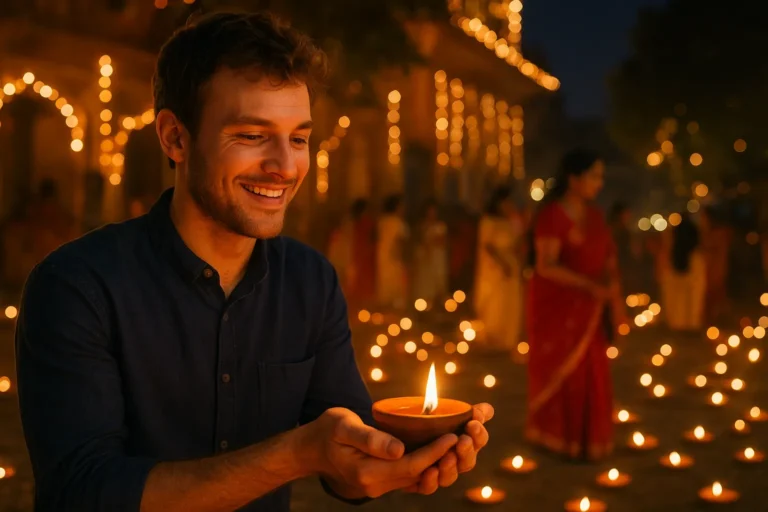
That night, Varanasi turned into a sea of light. The ghats were decorated with millions of diyas. It felt like the universe itself was watching. Local people welcomed me to join them. A man named Suresh helped me light a small diya and place it on the river.
“Make a wish,” he said.
I closed my eyes and wished for peace—for the world and for myself. When I opened them, my diya was drifting away, joining hundreds of others. In that moment, I understood what Diwali truly meant—not just lights, sweets, and celebrations, but the quiet hope that light will always find a way through the darkness.
Later, I joined a family for their home puja (worship). The women wore colorful sarees, and the men sang hymns with deep devotion. I sat silently, overwhelmed. There was a spiritual intensity in that room that words can hardly describe.
That night, I didn’t sleep. I just sat by the river, listening to the distant chants and watching the floating lights fade slowly downstream.
Mumbai – The City of Dreams and Fireworks
My final destination was Mumbai—a city that never sleeps. If Delhi was tradition and Jaipur was culture, Mumbai was pure energy.
I stayed near Marine Drive, and on Diwali night, the entire boulevard became a festival ground. Families gathered along the sea face, lighting sparklers and shouting “Happy Diwali!” to strangers like me. It was beautiful chaos—cars honking, people laughing, waves crashing, and fireworks exploding above the Arabian Sea.
I met a group of college students who invited me to their Diwali rooftop party. They shared homemade sweets and told me about the different ways people celebrate—some go to temples, others visit friends, while many donate food and clothes to those in need.
What touched me most was the generosity. Even in the middle of all the noise and celebration, people didn’t forget to give. I joined them the next morning to distribute food in a nearby slum. Seeing the joy in children’s faces when they received sweets and sparklers was something I’ll never forget.
That evening, I stood by the sea again. The reflection of fireworks on the waves looked like shimmering gold. I realized that Diwali isn’t just a festival—it’s a feeling. A reminder that no matter where you come from, everyone can find light in their own darkness.
The People, the Food, and the Soul of Diwali
Throughout my journey, one thing stayed constant—the hospitality of Indian people. From the Sharmas in Delhi to Kavita in Jaipur, Suresh in Varanasi, and the students in Mumbai—every person I met welcomed me as if I were part of their family.
And the food—oh, the food! Every city had its own signature dish. Samosas in Delhi, ghevar in Jaipur, malaiyyo in Varanasi, and modaks in Mumbai. Each bite carried a story, a tradition, a memory.
There was laughter, color, chaos, and calm—all coexisting. India, during Diwali, is not just a place; it’s an emotion that wraps around you.
Reflections – What Diwali Taught Me
When I boarded my flight back to America, my suitcase was filled with souvenirs—handmade lamps, sweets, bangles—but my heart carried something far greater.
Diwali taught me that light is not merely a physical thing. It’s in the way people smile at you, share food with you, or invite you to celebrate with them even if you’re a stranger.
I came to India looking for an adventure. What I found was belonging.
As the plane took off, I looked down at the faint glow of cities below—thousands of flickering lights stretching into the night. It felt like India itself was saying goodbye, promising that every darkness, no matter how deep, can be conquered by a single flame.
Epilogue – The Light Within
Even months after returning home, I found myself lighting a small candle every evening. It wasn’t Diwali anymore, but that light reminded me of the people I met, the prayers I witnessed, and the love I felt.
Diwali, I realized, isn’t about where you are. It’s about the light you choose to carry within.