
India is a land of myths, mysteries, and legends. As a traveler and storyteller, I have always been drawn to places where history blurs into folklore. Among all the places I’ve visited, none has shaken me to my core as much as Kuldhara Village in Rajasthan — a deserted settlement with a reputation for being one of the most haunted spots in India.
I am Abhilash Yadav, and this is the story of how I, along with my three friends, spent an entire night in Kuldhara, experiencing events that still make my spine tingle every time I recall them. This wasn’t just a travel experience — it was a journey into the unknown.
The Haunting Background of Kuldhara
Located about 20 kilometers from the golden city of Jaisalmer, Kuldhara was once a prosperous village of the Paliwal Brahmins. Legend says that in the 19th century, the entire population of the village vanished overnight. Some say they fled to escape the oppressive taxes and advances of a tyrannical ruler; others believe they left behind a powerful curse that no one could break.
Today, Kuldhara stands as a ghost village — crumbling homes, silent lanes, and an eerie stillness that even the wind seems to respect. Tourists visit during the day, but few dare to remain after dusk. The Rajasthan government itself discourages staying there at night.
But my curiosity got the better of me.
Why We Decided to Spend the Night
My three friends — Rahul, Ankit, and Deepak — and I had been on a road trip across Rajasthan, exploring forts, sand dunes, and heritage towns. When we reached Jaisalmer, we heard locals whisper about Kuldhara. “You can visit in the day, but don’t even think about staying there at night,” one shopkeeper warned us, shaking his head.
That warning only made our resolve stronger. We had visited haunted forts and temples before, but Kuldhara had a reputation that even skeptics respected. After some discussion, we decided to experience it firsthand.
We carried our cameras, a few snacks, flashlights, a portable speaker, and sleeping bags — but nothing could prepare us for what was to come.
Arrival at Kuldhara at Sunset
We reached the outskirts of Kuldhara around 6:30 pm. The sun was dipping below the horizon, painting the sandstone ruins in shades of orange and crimson. The gate to the village stood like a sentry to another world, its archway cracked but still imposing.
As we walked in, the air felt different — heavier, almost charged. The houses, once bustling with life, now stood roofless and empty, their doorways like gaping mouths. A lone owl hooted somewhere, and the sound echoed unnaturally.
We chose a spot near the remains of what seemed to be the village square, spreading our sleeping bags on the ground. The silence was overwhelming.
The First Hours of Darkness
By 8 pm, the temperature had dropped significantly. The desert sky above was stunning, filled with countless stars, but the beauty of it was overshadowed by the darkness enveloping Kuldhara.
We sat in a circle, speaking in hushed tones. Even the smallest sound — the crunch of sand underfoot, the distant bark of a dog — felt amplified. We recorded some videos for our travel blog, joking nervously, but deep down all of us felt uneasy.
Around 9:15 pm, Ankit said he heard soft footsteps behind one of the walls. When we shone our flashlights, there was nothing. A sudden gust of wind blew through, rattling loose stones and making the broken doors creak. It felt like the village was alive.
Midnight Approaches – The Atmosphere Changes
As midnight neared, the village grew colder and quieter. Even the insects seemed to stop making noise. Our flashlights began to feel inadequate, casting long shadows on the walls.
I remember checking my watch at 12:00 am exactly. We were all still awake, alert but tired. Deepak tried to play music on the speaker to lighten the mood, but the device suddenly switched off on its own. We assumed it was a battery issue, but when we checked, the battery was full.
That’s when Rahul muttered, “I feel like we’re being watched.”
The Encounter at 1:00 AM – The Spirits of Children
At exactly 1:00 am, something happened that none of us can explain to this day.
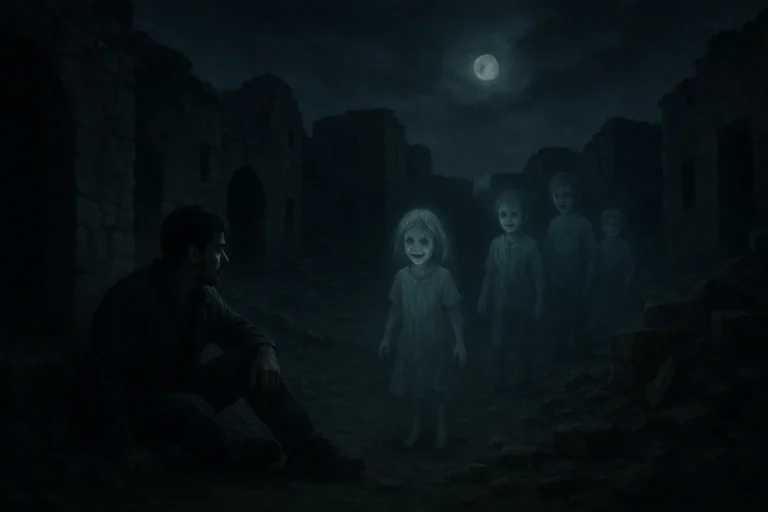
We heard giggling. Faint, but distinct — the sound of children laughing somewhere behind the ruins. We froze, exchanging panicked looks. There were no children in the village; no one at all except us.
The giggles grew louder, circling us, as if invisible children were running around. Our flashlights flickered. The air became icy, and I could see my breath in the beam of my light.
Then, out of the corner of my eye, I saw movement — a small figure darting behind a wall. It was pale, almost translucent. My heart raced. Ankit whispered, “Did you see that?” and I nodded slowly.
We called out, “Who’s there?” but received only silence. Then came a sound like marbles rolling on the ground. When we shone our lights, we saw small handprints in the sand, appearing as if pressed by invisible fingers.
I swear on everything I hold dear — at that moment, I felt a tug at the hem of my jacket. When I turned, there was no one.
Our Panic and the Whispers
We huddled closer together, our backs touching, scanning the ruins. The giggles had stopped, replaced by whispers — soft, incomprehensible words in an old dialect. Rahul, who understands some Rajasthani, said it sounded like the word “Chale jao” — “Go away.”
We were too scared to move but too terrified to stay. Our instincts screamed at us to leave, but our bodies felt frozen. The air around us felt thicker, like moving through water.
Then, suddenly, everything stopped. The whispers, the cold, the movement — gone. The village was silent again, as if nothing had happened. But the four of us sat there trembling, drenched in sweat despite the cold.
The Long Hours till Dawn
We didn’t sleep at all. We sat together, flashlights trained on the walls, waiting for dawn. Every creak or gust of wind made us jump. At one point, our car keys — which had been on the ground — were found ten feet away from where we had left them.
By 4:30 am, the first faint light of dawn appeared. Birds began to chirp, breaking the oppressive silence. The village seemed to relax, and so did we. When the sun finally rose, we packed our things in silence and walked quickly back to our car.
Reflections on What We Experienced
As we drove away, none of us spoke for a long time. Each of us was trying to process what had happened. Were we victims of mass hysteria? Did our imaginations conjure up ghosts from old legends? Or did we truly encounter the restless spirits of Kuldhara?
All I know is that what we experienced felt real — the giggles, the whispers, the tug on my jacket, the icy air. It was unlike anything I have ever felt before.
Even now, weeks later, when I close my eyes, I can hear those faint giggles echoing in my ears.
Tips for Visiting Kuldhara (If You Dare)
If you’re planning to visit Kuldhara, here are some tips based on my experience:
- Visit in the daytime if you’re faint-hearted. The ruins are beautiful and atmospheric even in sunlight.
- Avoid staying at night unless you’re mentally prepared. The village has a heavy energy after dark.
- Respect the site. Don’t litter, vandalize, or behave disrespectfully — it’s not just a tourist spot but a historical site tied to painful stories.
- Stay in groups. Never visit alone at night. The desert can be disorienting and dangerous.
- Trust your instincts. If something feels wrong, leave immediately.
Why This Experience Changed Me
As a traveler, I’ve always believed that places carry memories — echoes of the lives once lived there. But my night at Kuldhara taught me something deeper: some places carry not just memories, but presences.
That night tested my courage, my skepticism, and my understanding of the unseen. I went there as an adventurer seeking thrills; I left humbled, with a renewed respect for the mysteries of the world.
Final Thoughts
Kuldhara Village is more than just ruins. It’s a story frozen in time, a silent witness to a mass exodus and a legend that refuses to die. Whether you believe in ghosts or not, there’s no denying the energy of that place.
I, Abhilash Yadav, will never forget the night I spent with my friends there — a night when time seemed to pause, and the boundary between the living and the dead blurred.
Would I do it again? Probably not. But would I recommend others to visit Kuldhara? Absolutely — but only if they’re ready to face what lies beyond the veil of ordinary experience.