
By Rakesh Sharma, Reporter
Introduction: Expectations vs. Reality
When I booked my short trip to Nepal, I was expecting three things: peace, culture, and simplicity. As a reporter, I’ve often traveled across borders with my pen and notebook, documenting life as it unfolds. Nepal, with its Himalayan backdrop and spiritual aura, seemed like the perfect place to breathe, observe, and reflect.
But the Nepal I saw over three days was not the one painted in glossy travel magazines or Instagram reels. It was a nation boiling with anger, driven by its youngest generation. Gen Z — restless, ambitious, and deeply dissatisfied with their leaders — had taken to the streets. What was supposed to be a calm trip turned into a battlefield experience, where every decision felt like a test of survival.
For three days, I ran from roadblocks, dodged angry mobs, struggled to find food, and kept my ears sharp for the sound of gunfire or tear gas shells. What I saw wasn’t just protest; it was a mirror of a country’s wounded soul.
Day 1: Arrival into Chaos
I landed in Kathmandu with little idea of the storm that awaited me. The flight was smooth, the airport appeared calm, but the moment I stepped outside, reality slapped me hard. The roads were jammed with barricades — burning tires, young men and women shouting slogans, and police officers standing with shields.
At first, I thought it was a temporary demonstration, something that would disperse in an hour. But as my taxi driver nervously explained, “Sir, strike. Gen Z people… youth. Whole city blocked.”
The strike wasn’t just a small rally. It was a nationwide movement. Schools and colleges had been shut, transportation was paralyzed, and normal life had collapsed.
I tried to reach my hotel in Thamel, the popular tourist district. What should have been a 25-minute ride turned into a two-hour nightmare. At every junction, angry young protesters stopped vehicles, checked who was inside, and shouted at drivers. Many foreigners looked terrified, clutching their backpacks like shields.
By the time I reached the hotel, my nerves were rattled. The narrow lanes of Thamel were choked with confusion. Shops had their shutters down, restaurants were closed, and tourists were wandering helplessly, asking for food or water.
That night, I barely slept. The sound of shouting from distant streets, the crack of something exploding — perhaps fireworks, perhaps tear gas — echoed through the city. My first impression of Nepal had already turned into fear.
Day 2: When Fear Becomes Reality
If Day 1 was chaos, Day 2 was confrontation.
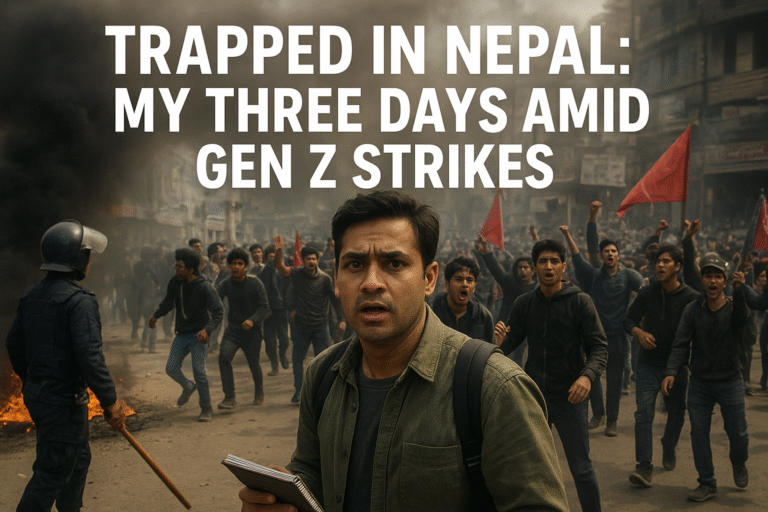
Early morning, I tried stepping out to cover the protests like a reporter would. The streets looked like a painting of anger. Youngsters — some barely out of school uniforms — were waving flags, chanting slogans against corruption, unemployment, and failed promises.
Their frustration was raw and unapologetic. “We are the future, but they killed our future,” one young man shouted as he pushed a barricade across the road.
As I tried to take notes and capture photos, a group noticed me. “Reporter? From India?” they asked sharply. For a few seconds, I froze, unsure whether they saw me as an ally or an outsider. The air was heavy with suspicion.
I nodded carefully. “Yes, but I’m here to observe, not interfere.”
They let me go, but the warning in their eyes was clear: don’t cross boundaries.
By noon, the protests had escalated. Police had begun pushing crowds back with batons. Tear gas shells filled the air with smoke that burned my eyes and throat. I ran with dozens of others, coughing, stumbling, trying to find clean air. For the first time, I felt the panic of survival.
Food became another problem. With shops closed, I walked for hours to find a small eatery that dared to open its shutters halfway. They served me a stale plate of dal-bhat and watery tea. Hunger made me finish it, but I knew the risk of food poisoning lingered.
The evening was worse. Protesters set fire to tires near my hotel. The smoke blackened the sky, and the acrid smell entered my room. Electricity went off for hours. Sitting in the dark, listening to angry voices and sirens outside, I wondered if I would even make it back home alive.
Day 3: The Hardest Day
If the first two days were warnings, Day 3 was the explosion.
The protests spread beyond Kathmandu. Roadblocks appeared on highways, and news came of violent clashes in smaller towns. I had planned to visit Bhaktapur for reporting, but locals strongly advised against it. “Too dangerous. You won’t come back,” they said bluntly.
Still, I wanted to see the ground reality. Against advice, I took a shared van heading in that direction. Halfway, we were stopped by a mob. They dragged passengers out, shouting slogans, and demanded everyone raise their voices in support.
I stood silent, unsure what to do. A young boy, no more than 17, pointed at me and shouted, “Who are you? Speak!”
I could feel sweat running down my back. I quickly raised my hand and muttered the same words others were chanting, just to blend in. My heart was racing, but survival demanded compromise.
By afternoon, the city was in flames — not metaphorically, but literally. Tires burned at every junction, protesters clashed with police, and foreigners were advised to stay locked inside their hotels. I stayed glued to the window, watching a city unravel.
At one point, I heard loud banging on the hotel doors. Protesters had entered the street, forcing shopkeepers to shut down completely. The fear of being attacked simply for being an outsider was real.
That night, I barely ate. Fear is an appetite killer. I wrote notes under the dim light of a dying candle, my reporter’s instinct fighting my human fear. Never before had I felt the line between observer and victim blur so strongly.
Reflections as a Reporter
Looking back at those three days, I realize Nepal is standing at a dangerous crossroads.
Gen Z — born in the shadow of a civil war, raised amid broken promises, and now staring at unemployment and corruption — has decided not to stay silent. Their anger is not random; it’s rooted in years of systemic failure.
As a reporter, I can understand their frustration. But as a traveler, I saw the devastating cost. The economy suffers, tourism collapses, and ordinary citizens struggle to find food, water, or safety.
Nepal’s beauty lies in its mountains, culture, and spirituality. But none of that matters when the streets are unsafe. The strikes showed me a nation restless, a generation demanding change, and a fragile system unable to deliver it.
The Gen Z protests are more than a strike — they’re a cry for dignity, for future, for hope. But until leadership listens, travelers like me will continue to walk the thin line between exploration and survival.
Conclusion: Lessons from Nepal
When I boarded my flight back to India, I carried more than just notes; I carried scars of fear and memories of survival. Nepal taught me that even the most beautiful countries can reveal their darkest faces when unrest takes over.
For three days, I wasn’t a tourist or a reporter. I was just a man trying to stay alive.
To future travelers, my advice is simple: check the ground reality before you visit. Nepal is breathtaking, but when its youth are on the streets, even the strongest traveler can feel helpless.
As for me, I left with mixed feelings — admiration for the courage of Nepal’s youth, but also deep concern for a nation at war with itself. My story is not one of temples or mountains, but of barricades, smoke, and a desperate fight to breathe.
Three days in Nepal felt like three years. And I, Rakesh Sharma, will never forget the time I struggled not just to report, but to survive.