
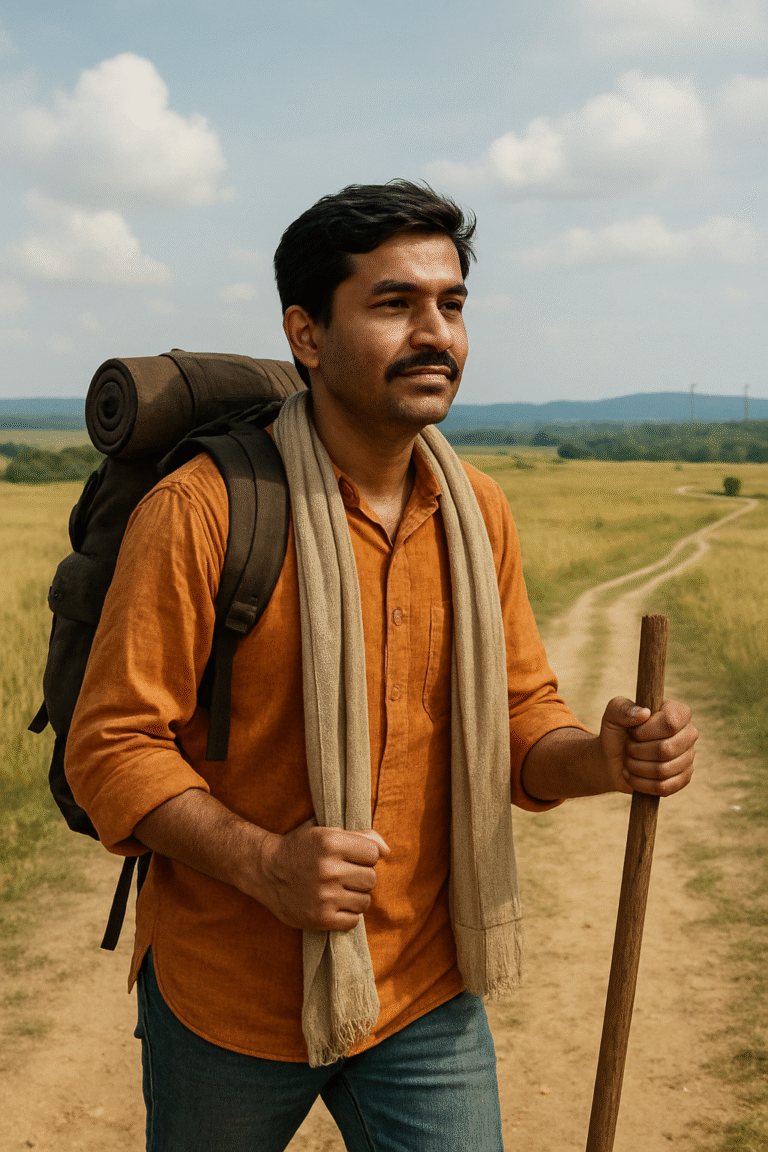

By Amit Chandrakar
There’s a moment, when you stand at the edge of a forest, stare across an endless savanna, or listen to glaciers groan under their own ancient weight, when you realize how small you are. And in that smallness, you feel infinite. That’s the gift nature gives to travelers like me. Over the past five years, I’ve wandered through jungles, deserts, mountains, and oceans on all seven continents—searching not just for sights, but for a connection to the raw pulse of the Earth.
This isn’t a checklist of destinations. It’s the story of how the world’s wild places spoke to me—and how they might speak to you too.
Asia: The Living Heartbeat of Nature
My journey began where my roots lie: in Asia.
In the Indian Himalayas, I trekked through pine-scented air, prayer flags snapping in icy winds. At Roopkund, where skeletal remains lie beneath a frozen lake, I was reminded how even death folds gently into nature’s embrace. The sun rose over the peaks in hues of saffron and gold, and I felt as if I was watching creation happen again.
Further east, I paddled through the emerald waterways of Vietnam’s Ha Long Bay, limestone karsts rising like the bones of ancient gods from the misty sea. Birds nested in the cliffs, and the silence felt holy, broken only by the splash of oars and the occasional call of a hornbill.
Then there was Japan in spring, where cherry blossoms fluttered to the ground like soft pink snow. In Yakushima, a remote island covered in ancient cedar forests, I stood before the Jomon Sugi, a tree over 2,000 years old. I pressed my palm to its mossy bark and thought about all the storms it had survived, all the seasons it had seen.
Asia’s nature is alive in a way that feels personal—as though the land remembers and welcomes every footstep.
Africa: The Pulse of the Earth
Africa changed me.
In Tanzania, on the Serengeti, I watched the Great Migration—millions of wildebeest and zebra surging like a river of muscle and dust across the plains. A cheetah crouched in the grass nearby, her eyes fixed on a gazelle. Life and death were everywhere, raw and unapologetic.
One dawn, I climbed Mount Kilimanjaro, past the rainforest and into the alpine desert, until I stood above the clouds on Uhuru Peak. The glacier shimmered blue in the morning sun. Here, I saw how even the tallest mountain can feel fragile—its ice retreating each year as the climate changes.
Later, in Botswana’s Okavango Delta, I glided in a mokoro canoe, the water so clear I could see fish darting between reeds. Elephants waded past, silent but powerful. A lilac-breasted roller flashed through the air, its wings a blur of turquoise and violet.
Africa taught me that nature is not a backdrop. It is the stage, the play, and the audience all at once.
Europe: Where Wilderness Hides in Plain Sight
Europe isn’t always the first place people think of for wilderness, but its natural beauty surprised me.
In Norway, I hiked the Lofoten Islands, jagged peaks rising straight from icy fjords. The midnight sun bathed the world in golden light for hours, and I felt a strange, giddy sleeplessness as I walked along the coastline.
In Slovenia, I kayaked through the emerald waters of Lake Bled, a lone church on an island ringing with the sound of bells. And in Iceland, I marveled at the rawness of the earth itself: geysers shooting scalding water skyward, black sand beaches littered with diamond-like icebergs, and the haunting glow of the Northern Lights rippling across a winter sky.
Even in the well-trodden Alps, wildness persisted. In Switzerland, marmots scurried among wildflowers, and eagles wheeled above glaciers.
Europe showed me that nature doesn’t have to be vast to be profound. It thrives in patches, in protected reserves, and sometimes even in city parks.
South America: The Lungs and Soul of the Planet
If there’s a place on Earth that feels like its breathing center, it’s the Amazon.
I entered the rainforest from Manaus, Brazil, and for days moved deeper by boat and on foot. The air was thick with humidity and life—howler monkeys calling from the canopy, macaws flashing red and gold, and caimans sliding silently into the river.
At night, under a net of stars, I heard insects singing in a thousand pitches, and I felt the jungle’s heart beating around me.
In Peru, I stood at the top of Machu Picchu at sunrise, mist curling around stone walls. The ancient Inca city felt less like a ruin and more like a seed growing out of the mountains.
Then came Patagonia, on the southern tip of the continent. Here, in Argentina and Chile, the landscapes were vast and humbling: jagged granite spires, turquoise glacial lakes, and winds so strong they nearly knocked me off my feet.
South America whispered and roared in equal measure.
North America: Wild at Its Core
From the icy wilds of Alaska to the deserts of Arizona, North America offers nature in all its extremes.
In Yosemite National Park, I stood beneath the towering sequoias—some older than recorded human history. I watched sunlight cascade down El Capitan, climbers like tiny ants inching their way up the sheer rock face.
In Yellowstone, I saw bison grazing as steam rose from the earth, the smell of sulfur in the air. A grizzly bear crossed the road ahead of me one dusk, and I stayed very still, my heart pounding so loudly I was sure he could hear it.
The Canadian Rockies stunned me with their serenity. I kayaked on Moraine Lake, its water an impossible shade of blue, and hiked through fields of wild lupines and columbines. And in the Sonoran Desert, I learned to love the quiet. The cacti stood like sentinels, the sky stretching forever, and the sun setting in a blaze of orange and violet
Australia and Oceania: Nature’s Wild Card
Australia reminded me how strange and wonderful nature can be.
On the Great Barrier Reef, I swam among coral gardens teeming with fish of every hue. A sea turtle glided past, unhurried and ancient, and I followed in awe.
In the Australian Outback, I camped under a sky glittering with stars, the Milky Way so bright it felt close enough to touch. Uluru rose like a heartbeat from the red earth, glowing amber at sunrise.
In New Zealand, I hiked the Milford Track, waterfalls cascading down mossy cliffs, the air damp and sweet with the smell of ferns. Here, the world felt young and untamed, as though dinosaurs might still roam the valleys.
Even the tiny islands of the Pacific offered wonders: in Palau, I floated in a lake filled with millions of harmless jellyfish, their soft bodies pulsing like living lanterns around me.
Antarctica: The White Silence
And finally, to the end of the Earth.
Antarctica is a place beyond words.
I sailed past icebergs as big as cathedrals, their surfaces carved by wind and waves into surreal shapes. Penguins waddled along the shore, fearless of our presence. Humpback whales breached near our zodiac boat, their massive bodies arcing out of the freezing water.
There was no noise here except the crack of ice and the call of seabirds. No trees, no grass—only rock, snow, and sky. And yet, the barrenness was beautiful, a reminder that life endures even in the harshest places.
Standing there, I felt both alone and profoundly connected to every living thing on the planet.
What I Learned from the Wild
Traveling through nature isn’t just about seeing landscapes—it’s about feeling them. Every place I visited had its own rhythm, its own lessons:
- The Himalayas taught me humility.
- The Amazon taught me to listen.
- The Outback taught me patience.
- Antarctica taught me reverence.
In a world where we so often wall ourselves off from the natural world, these places broke those walls down for me.
The wild doesn’t belong to us. If anything, we belong to it.
Why You Should Go
You don’t have to cross continents to find wonder. Start small: a forest trail near your home, a lake at dawn, the stars on a clear night. The Earth is alive everywhere.
But if you ever get the chance, go further. Stand at the edge of a glacier, float down a jungle river, walk barefoot across desert sand. Let the world remind you how vast and fragile and beautiful it is.
Because one day, it might be too late. And I can promise you this: nature’s voice is worth hearing.
Where will you go first?